Newton's Second Law
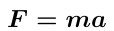
The relationship of Force to Acceleration is not a rate of change, like the other similar relationships we've seen before. Force and acceleration are the same sort of thing: both describe change in motion. The difference between them is that force, which represents how hard I am pushing on an object, must be larger or smaller based on the mass of the object if I am to produce the same acceleration.
An equation like this is trying to represent not a process ("acceleration is what I add to my velocity each second") but a relationship between two things. By saying "F = ma", I mean, "The more massive an object is, and the more I want to accelerate it, the more I have to push."
In general, if you have an equation solved for any one variable, you can see how that variable will be affected by change in the other variables. If, for example, we solve for a = F / m, we can see that a will grow as F grows (because F is in the numerator, being multiplied) but that a will shrink when m grows (since m is in the denominator, being multiplied). This matches what we might expect: it is harder to accelerate a heavier object.- How much force is required to accelerate a 30 kg cart at a rate of .5 m/s²?
- I find out that it takes 40 N of force to accelerate a box at a rate of 5 m/s². What is the mass of the box?
- Suppose that a 500 kg car is initially at rest. If its engine exerts a force of 2000 N for five seconds, how fast will the car end up going?
- Suppose that you have the job of delivering newspapers. You deliver 100 newspapers, each morning, by bicycle.
a) Will you find it easier to start and stop your bike at the start of your route, or at the end? Why?
b) Might you notice a difference, between the start an end of the route, in how hard you have to pedal to keep the bike going once it is moving? Why or why not?
- Mr. Z. is walking home from the store in the rain, carrying 100 pounds of milk in paper bags, when he realizes that it is suddenly a lot easier to start, stop, and turn corners. Why does this ease of acceleration worry him?
- We know that the acceleration produced by gravity is the same for all objects: g = 10 m/s². The force of gravity pulling down on an object is called its weight. What is the weight of a 3 kg bowling ball? Why do we bother to differentiate between weight and mass?
Answers: 1-3) The sum of your answers should be 43. 4) You have to be able to imagine what this situation looks like. The salient fact here is that you start out carrying 100 newspapers and end up with none. 5) Again, imagination is key. 6) 30 N